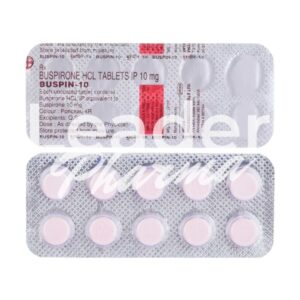
Buspirone

In stock
5mg · 10mg
from 20,98 £
In brief
Buspirone is an anxiety medicine whose action involves serotonin signalling. Improvement is gradual, and the response is assessed over time rather than after a single use.
Mechanism of action and pharmacology
Understanding buspirone’s pharmacology helps clarify why it functions differently from common benzodiazepine medications. Rather than depressing the central nervous system, buspirone works as a selective serotonin receptor agonist – primarily targeting 5-HT1A receptors with minor effects on dopamine pathways.
Clinical effects gradually build over 2-4 weeks, though the substance reaches peak plasma concentration within 60-90 minutes after ingestion. The liver’s CYP3A4 enzyme system metabolises buspirone before it’s eliminated through urine, with a relatively short half-life of 2-3 hours necessitating multiple daily doses.
Critical interactions include:
- MAO inhibitors (risk of hypertensive crisis)
- Grapefruit juice (significantly slows metabolism)
- Alcohol (intensifies dizziness)
Medical professionals emphasise these interactions during consultations to ensure safe buspirone therapy.
Approved and off label uses
In the UK, buspirone is licensed for the short-term management of anxiety disorders. It is generally used after SSRIs and SNRIs, particularly when patients experience unacceptable side effects from first-choice treatments.
Doctors occasionally prescribe buspirone off-label for depression showing inadequate response to standard antidepressants, though evidence remains limited. There’s emerging interest in its potential application for obsessive-compulsive disorder symptoms, though this falls outside current prescribing guidelines.
Special considerations apply to certain patient groups:
This medication isn’t approved for children due to insufficient safety data. Elderly patients typically start at reduced dosages around 5mg twice daily. Pregnancy brings additional safety considerations where prescribers weigh potential benefits against possible risks.
prohibit buspirone use entirely. Concurrent MAOI antidepressants (like phenelzine or tranylcypromine) create highest risk due to potentially fatal serotonin syndrome. Immediate hypersensitivity reactions to azapirones, though rare, also mandate permanent avoidance.
This medication isn’t approved for children due to insufficient safety data. Elderly patients typically start at reduced dosages around 5mg twice daily. Pregnancy brings additional safety considerations where prescribers weigh potential benefits against possible risks.
Relative contraindications require careful evaluation before prescribing. Severe liver impairment (Child-Pugh Class C) or advanced kidney disease (eGFR <30 mL/min) necessitate dosage reductions or alternative treatments due to impaired drug metabolism/excretion. History of epilepsy warrants caution since buspirone may lower seizure threshold. Interactions with CYP3A4 inhibitors (grapefruit juice, macrolide antibiotics) heighten this risk.
Other precautions also apply. Gradually taper doses instead of abrupt cessation to minimise emergent anxiety despite low dependency risk. Parkinson’s disease patients require monitoring for worsened tremor control.
Side effects & risk management
Common buspirone reactions differ by frequency and severity:
| Common side effects | Serious reactions (rare) |
|---|---|
| Dizziness | Serotonin syndrome* |
| Nausea | Facial/throat swelling (angioedema) |
| Headache | New/worsening suicidal thoughts |
| Nervousness/restlessness | Seizures |
*Especially dangerous when combined with SSRIs/MAOIs
Effective management improves tolerance. Taking doses with food reduces nausea intensity. Standing slowly minimises dizziness. Avoid driving during initial treatment until dizziness settles. Report facial swelling immediately or call NHS 111.
UK alternatives
UK prescribers follow NICE anxiety guidelines prioritising SSRIs before considering buspirone as third-line therapy:
| Medication (form) | Key advantages | Limitations |
|---|---|---|
| Buspirone (10mg tablets BID) | Non-addictive, minimal sedation | Slow onset (2-6 weeks) |
| Sertraline (50mg daily) | First-line NICE recommendation | Sexual dysfunction, GI side effects |
| Diazepam (5mg PRN) | Rapid symptom relief | Addiction potential, drowsiness |
| Pregabalin (75mg BID) | Reduces somatic anxiety symptoms | Abuse liability, weight gain |
GPs often prefer sertraline initially except where sedation avoidance is critical.
Frequently asked questions
Can I drink alcohol with buspirone?
Avoid alcohol entirely – interactions increase dizziness risks significantly. Combining them intensifies sedative effects.
Avoid alcohol entirely – interactions increase dizziness risks significantly. Combining them intensifies sedative effects.
Does buspirone cause weight changes?
Weight changes are uncommon; unlike many SSRIs, buspirone has little effect on appetite.
Weight changes are uncommon; unlike many SSRIs, buspirone has little effect on appetite.
Is buspirone NHS-funded?
Yes – buspirone is available on NHS prescription.
Yes – buspirone is available on NHS prescription.
Guidelines for proper use
Adherence protocols ensure therapeutic effectiveness. Maintain consistent intake times regardless of meals. Avoid grapefruit products – they inhibit metabolising enzymes causing adverse interactions. Abstain from operating heavy machinery until response tolerance is established.
Storage demands temperature control below 25°C. Keep tablets sealed within original blister strips. Discard immediately if strips show punctures or discolouration. Patient safety notes emphasise never sharing medication and reporting suicidal thoughts promptly to GPs.