Sertraline
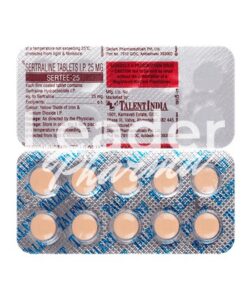
In stock
25mg · 50mg · 100mg
from 33,06 £
In brief
- Sertraline is an SSRI antidepressant, licensed in the UK as a prescription-only medicine for depression and several anxiety disorders.
- Available here as 25 mg, 50 mg and 100 mg tablets, in packs ranging from 30 to 360 tablets.
- Adults usually start on 25 mg or 50 mg once a day; the daily ceiling in the SmPC is 200 mg.
Sertraline: what it is and the conditions it treats
Sertraline is an antidepressant from the selective serotonin reuptake inhibitor (SSRI) family. By slowing the re-absorption of serotonin into nerve cells, it leaves more of this messenger available in the brain, which over a period of weeks can lift low mood and quieten persistent anxiety. Under the UK SmPC, adults may be prescribed it for major depressive episodes and for keeping them from returning, and also for panic disorder with or without agoraphobia, obsessive-compulsive disorder (OCD), social anxiety disorder and post-traumatic stress disorder (PTSD). In children and teenagers aged 6 to 17, OCD is the only licensed use.
Strengths and pack sizes
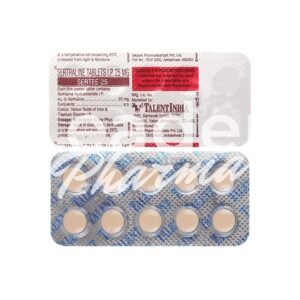
Three strengths are listed on this page: 25 mg, 50 mg and 100 mg, each supplied in packs of 30, 60, 90, 120, 180, 270 or 360 tablets. These are imported generic tablets; sertraline itself, in all three strengths, is licensed in the UK. The 25 mg tablet fits the gentle first week used in some anxiety disorders, while the 50 mg and 100 mg tablets cover the more usual maintenance amounts.
How the dose is worked out
For depression and OCD, adults normally begin on 50 mg once daily. In panic disorder, social anxiety disorder and PTSD the opening week is usually 25 mg before moving up to 50 mg, which helps to limit the restlessness some people feel at the start. If the response is not good enough, the dose can be raised in 50 mg steps, no more than once a week, to a maximum of 200 mg a day. Sertraline tablets are taken once a day, either in the morning or in the evening, with or without food. Some improvement may show within the first week, yet the full benefit generally takes longer, especially in OCD. Once depression has lifted, treatment normally carries on for at least six months. People with liver problems need a lower or less frequent dose, and the medicine is not used in severe liver impairment.
UK licensing and brand names
In the UK, sertraline is a prescription-only medicine (POM). The original brand, Lustral, is now held by Viatris and comes as 50 mg and 100 mg film-coated tablets. Generic film-coated tablets are licensed in 25 mg, 50 mg, 100 mg, 150 mg and 200 mg strengths, and an oral concentrate exists for those who cannot manage tablets. Whether this treatment is suitable, and at what dose, is for the doctor or other prescriber to decide.
When it should be avoided and medicines that interact
Irreversible monoamine oxidase inhibitors (MAOIs) must not be taken at the same time: treatment can only begin 14 days after such an MAOI has been stopped, and a gap of at least 7 days is needed after the last sertraline dose before an MAOI is started. Pimozide is contraindicated as well. Combining it with triptans, tramadol, lithium, St John’s wort or other serotonergic medicines increases the chance of serotonin syndrome, with agitation, tremor, sweating and a high temperature. Extra caution is advised in epilepsy, bipolar disorder, a tendency to bleed or use of anticoagulants, low blood sodium in older people and heart rhythm problems linked to QT prolongation. Adults under 25 need close monitoring for suicidal thoughts during the first weeks.
Side effects and coming off treatment
Among the most frequent effects described in the SmPC are nausea, diarrhoea, a dry mouth, headache, dizziness, drowsiness or poor sleep, tiredness and delayed or failed ejaculation; many of these ease after the first few weeks. Less common but more serious problems, such as unusual bruising or bleeding, confusion caused by low sodium or a sudden switch into a high, excitable mood, need prompt medical advice. Stopping sertraline abruptly can trigger dizziness, pins and needles, disturbed sleep, anxiety or irritability, so the dose is usually tapered over at least one to two weeks.