Fludrocortisone
In stock
100 mCg · 100mcg
from 44,58 £
In brief
- Fludrocortisone is a mineralocorticoid steroid that replaces aldosterone in Addison's disease and salt-losing adrenogenital syndrome.
- Each tablet holds 100 micrograms (0.1 mg) of fludrocortisone acetate; packs run from 30 to 360 tablets.
- A prescription-only (POM) medicine in the UK, normally taken alongside hydrocortisone or cortisone.
Fludrocortisone as aldosterone replacement
Fludrocortisone acetate is a synthetic corticosteroid whose main action resembles aldosterone, the hormone the adrenal glands release to hold on to sodium and water and to let potassium go. When the adrenal cortex fails, as in Addison's disease, that salt-retaining signal is lost, leading to low blood pressure, dizziness on standing and salt craving. The UK SmPC licenses the tablets for partial replacement therapy in primary adrenocortical insufficiency and for salt-losing forms of adrenogenital syndrome (congenital adrenal hyperplasia). Because the glucocorticoid effect is small at replacement doses, cortisone or hydrocortisone by mouth is given alongside it when that extra cover is required.
One 100 microgram tablet, several box sizes
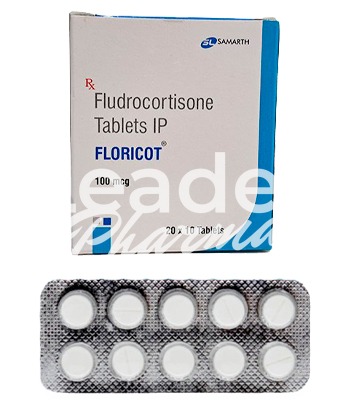
Only one strength is listed: 100 micrograms per tablet, the same as 0.1 mg. Pack sizes are 30, 60, 90, 120, 180, 270 and 360 tablets. The box shown in the photograph is an imported generic rather than a UK-licensed pack. In the UK the medicine is classed as POM and supplied as generic 0.1 mg tablets from several licence holders, alongside 0.05 mg tablets and an oral solution. Certain UK versions must be kept in the fridge, so the storage instructions on whichever pack is dispensed are worth checking.
How much is taken each day
The SmPC gives an adult range of 0.05 to 0.3 mg a day by mouth, which is up to three tablets of this strength. Where a dose of 0.05 mg is wanted, a 0.05 mg product is used rather than halving a tablet, since the score line on the UK tablet is meant to aid swallowing rather than to create equal halves. In children the usual amount is 0.05 to 0.1 mg daily, tailored to age, weight and severity. Salt intake and the dose are watched together, and blood electrolytes are checked periodically on long-term treatment, because an excess shows up as high blood pressure, fluid retention or weight gain. Stopping after prolonged use should be gradual, and extra steroid cover may be needed during surgery, injury or serious illness.
Steroid card, infections and other precautions
People on long-term fludrocortisone should carry a steroid treatment card recording the dose, the prescriber and how long they have been taking it. A systemic infection is a contraindication unless it is being specifically treated, and the medicine should not be used for conditions outside its licence because of its strong salt-retaining effect. Anyone who has not had chickenpox or measles should seek medical advice promptly after contact with either, and live vaccines are avoided. Care is advised with heart failure, high blood pressure, kidney disease, osteoporosis, diabetes, glaucoma, peptic ulcer, epilepsy, past tuberculosis and a personal or family history of severe mood disorder. Blurred vision should prompt an eye check.
Interactions to mention
Diuretics, amphotericin B and other potassium-lowering medicines increase the risk of low potassium, which in turn makes digoxin toxicity more likely. Carbamazepine, phenytoin, primidone, barbiturates, rifampicin and rifabutin speed up the breakdown of fludrocortisone, whereas ketoconazole, cobicistat and other CYP3A inhibitors can heighten steroid effects. Oestrogens, including combined hormonal contraceptives, may raise levels too. Blood glucose control, warfarin response and blood pressure treatment can all be affected, and the gut risks of NSAIDs are greater in combination.
Possible side effects
Most adverse effects stem from salt and water retention: raised blood pressure, oedema, low potassium, heart enlargement and congestive heart failure. Headache and muscle weakness are listed as common, while seizures, fainting, taste changes, diarrhoea and hallucinations are uncommon. Mood changes, including low mood or agitation, should be reported quickly. Too rapid a dose reduction after long use can trigger an adrenal crisis, which needs urgent attention at A&E.
A note on supervision
The dose of fludrocortisone is set and adjusted by the endocrinologist or GP in charge of treatment.