Hypnite
In stock
3mg · 2mg · 1mg
from 24,52 £
In brief
- In our pharmacy, you can purchase Hypnite without a prescription, with delivery in 9–21 days throughout the United Kingdom. Discreet and anonymous packaging.
- Hypnite (eszopiclone) treats insomnia by enhancing GABA activity in the brain, promoting sleep initiation.
- Usual dosage is 2–3 mg at bedtime for adults (max 3 mg/day); elderly start at 1 mg.
- Administered orally as tablets.
- Onset occurs within 30–60 minutes after ingestion.
- Duration of action lasts approximately 6–8 hours, supporting a full night's sleep.
- Alcohol consumption is strongly discouraged—it intensifies sedation risks.
- Most common side effects: metallic taste, dry mouth, dizziness, and next-day drowsiness.
- Would you like to try Hypnite without a prescription?
Basic Hypnite information
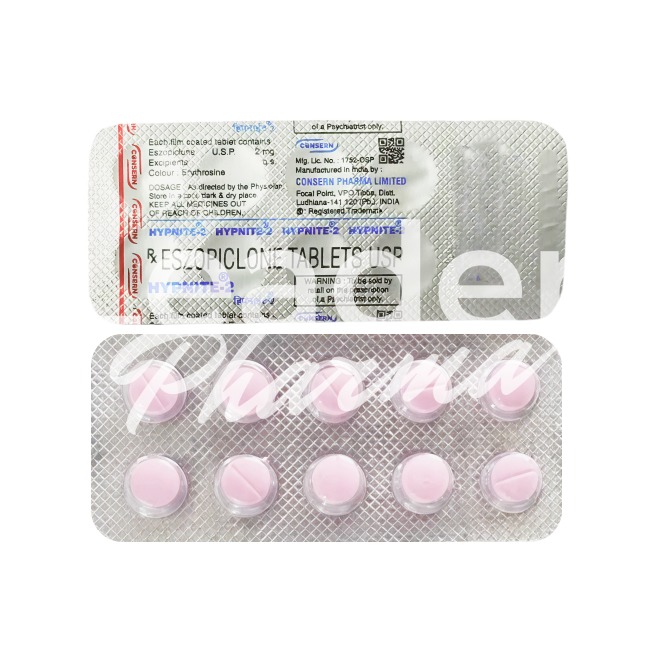
Hypnite contains the active ingredient eszopiclone, classified as a non-benzodiazepine hypnotic medication used for insomnia treatment. Hypnite is not licensed in the UK; its active ingredient eszopiclone is a prescription-only medicine (POM). Common packaging includes foil blister packs containing round, film-coated tablets typically in 1mg, 2mg and 3mg strengths. Its Anatomical Therapeutic Chemical (ATC) code is N05CF04, categorising it under nervous system drugs specifically for hypnotics and sedatives.
| Property | Details |
|---|---|
| INN | Eszopiclone |
| Brand names | Hypnite, Lunesta |
| Available strengths | 1mg, 2mg, 3mg tablets |
| Packaging format | Blister packs (10/14/30 tablets) |
| Registration status | Not licensed in the UK |
| Classification | Prescription-only medicine (POM) |
How Hypnite works: mechanism and metabolism
Eszopiclone modulates GABA-A receptors in the central nervous system, enhancing GABA's inhibitory effects. Unlike traditional benzodiazepines, it selectively binds to receptor subunits involved with sedation rather than muscle relaxation. This precise action reduces insomnia symptoms while limiting next-day cognitive impairment.
| Parameter | Value | Significance |
|---|---|---|
| Peak Concentration | 1 hour | Rapid sleep onset |
| Elimination Half-Life | 6 hours | Short duration minimises residual effects |
| Primary Metabolism | CYP3A4 Liver Enzymes | Vulnerable to drug interactions |
| Bioavailability | ~80% | Highly absorbed orally |
Critical interaction risks
- CNS depressants: Opioids, benzodiazepines or antipsychotics significantly increase sedation risk
- Alcohol: Intensifies drowsiness and impairs coordination
- Grapefruit juice: Inhibits CYP3A4 metabolism, elevating blood concentrations
- Rifampicin: Induces metabolism, reducing effectiveness
Renal impairment requires minimal adjustments but hepatic dysfunction necessitates dosage reductions.
Approved uses and usage restrictions
Hypnite is used exclusively for short-term adult insomnia management when non-pharmacological approaches prove ineffective. Treatment duration typically ranges from several days to a maximum of four weeks clinically. Off-label applications are uncommon due to substantial dependence risks with extended use.
Population-specific considerations
Paediatric patients under 18 are contraindicated due to unestablished safety profiles. Geriatric populations experience heightened sensitivity requiring cautious titration starting from 1mg. Severe hepatic impairment necessitates dose ceilings of 2mg nightly. Pregnancy and breastfeeding necessitate rigorous risk-benefit evaluations.
Hypnite dosage and administration guidance
Standard adult dosing involves:
- Healthy adults: 2mg-3mg taken immediately before bedtime
- Elderly/debilitated patients: Initial 1mg dose with optional escalation to 2mg
- Severe hepatic impairment: Maximum 2mg nightly
Administer tablets whole without food interactions concerns. If forgetting a scheduled dose, skip the missed dose completely rather than doubling subsequent quantities. Consistency supports efficacy as erratic dosing promotes tolerance. Store packages at standard room temperature between 15°C-30°C with protective moisture barriers maintained intact.
Absolute contraindications & warnings
Hypnite carries absolute contraindications requiring immediate attention before prescription. Never use this medication if you've experienced prior hypersensitivity reactions to eszopiclone or any tablet ingredients. Patients with severe hepatic impairment must avoid Hypnite entirely due to impaired metabolism. Crucially, anyone with documented complex sleep behaviours like sleepwalking or sleep-driving triggered by sedative-hypnotics should not receive this treatment.
Specific warnings require clinician vigilance. Eszopiclone carries a warning about complex parasomnias - unpredictable night-time activities performed without full awareness. Patients require monitoring for respiratory depression risks, particularly those with severe sleep apnoea. Medical histories revealing substance misuse, alcoholism, or depression warrant cautious evaluation due to potential dependence risks. Always disclose pregnancy status - while no major teratogenic effects are confirmed, Hypnite crosses the placental barrier, making pregnancy a relative contraindication requiring thorough benefit-risk discussions.
Monitoring requirements
- Assess daytime residual effects (drowsiness/coordination issues) at follow-up appointments
- Document any emerging depressive symptoms or behavioural changes
- Review alcohol consumption patterns due to synergistic CNS depression
Common to rare side effects
Hypnite users typically experience predictable adverse effects ranging from mild to severe. The most common are a persistent metallic taste disturbance and dry mouth. Morning drowsiness can impair alertness during commuting or work hours, and transient dizziness during night-time bathroom visits can occur, increasing fall risks particularly in elderly patients.
Though less common, significant complications require prompt medical attention. Some patients develop memory disturbances or dose-related amnesia. The most serious recorded events include anaphylaxis and respiratory depression in susceptible patients. Crucially, prolonged usage beyond 4 weeks substantially increases dependence risks and medication tolerance, necessitating strict adherence to short-term prescribing guidance for insomnia.
| Symptom frequency | Side effects |
|---|---|
| Very common | Unpleasant metallic taste, morning fatigue |
| Common | Dry mouth, headache, transient dizziness |
| Uncommon | Gastrointestinal upset, nightmares |
| Rare | Severe allergic reactions, respiratory suppression |
Alternative sleep aids comparison
When Hypnite proves unsuitable, alternatives with distinct mechanisms and safety profiles may be considered.
| Medication | Key differentiators |
|---|---|
| Zolpidem (Stilnoct) | Faster onset but shorter duration vs Hypnite |
| Zopiclone (Zimovane) | Longer half-life, higher morning drowsiness risk |
| Temazepam | Benzodiazepine, restricted to severe short-term use |
Cognitive Behavioural Therapy for Insomnia (CBT-I) remains the preferred NHS frontline intervention before considering pharmacological options, aligning with NICE guidance on avoiding long-term hypnotic prescriptions.
Frequently asked questions (FAQ)
Common patient queries answered
Can I combine Hypnite with ibuprofen?
Avoid this combination entirely due to amplified dizziness risks. Paracetamol represents a safer alternative if pain relief is required.
Avoid this combination entirely due to amplified dizziness risks. Paracetamol represents a safer alternative if pain relief is required.
Does Hypnite cause permanent memory impairment?
No established evidence links eszopiclone to long-term cognitive decline when used as directed. Report persistent confusion immediately to your GP.
No established evidence links eszopiclone to long-term cognitive decline when used as directed. Report persistent confusion immediately to your GP.
How quickly does Hypnite take effect?
Peak concentrations occur within 60 minutes. Take precisely at bedtime since prompt drowsiness prevents safe activity.
Peak concentrations occur within 60 minutes. Take precisely at bedtime since prompt drowsiness prevents safe activity.
Can I split Hypnite tablets?
Never alter tablets without medical supervision. Scored versions permit precise dose reduction under pharmacist direction.
Never alter tablets without medical supervision. Scored versions permit precise dose reduction under pharmacist direction.
Guidelines for proper use
Take Hypnite only at bedtime; taking it on an empty stomach helps consistent absorption. Vital precautions include:
- Total alcohol avoidance during treatment periods
- Next-day driving restrictions until effects fully resolve
- Secure storage in original packaging away from humidity
Never take additional tablets for night-time waking - this dangerously escalates overdose potential. Patients commonly misinterpret dosing requirements so always double-check instructions against the Patient Information Leaflet included with packaging, particularly regarding new medication combinations.
Overdose protocol & emergency
Never duplicate doses following missed administration. Seek emergency help immediately if overdose symptoms appear:
- Profound respiratory depression
- Unresponsive unconsciousness
- Dangerously low blood pressure
Call 999 without hesitation upon suspecting overdose. Provide all relevant details to ambulance crews including quantity ingested and timing. Contact the UK National Poisons Information Service (0344 892 0111) concurrently for clinical management guidance. Note naloxone remains ineffective for eszopiclone toxicity reversal.