Memantine
In stock
10mg
from 66,88 £
In brief
- Memantine is a prescription-only (POM) medicine for adults living with moderate to severe dementia of the Alzheimer's type.
- Offered as 10 mg film-coated tablets in boxes of 30, 60, 90, 120 or 180.
- Started at 5 mg and raised by 5 mg a week; 20 mg once daily is both the target and the ceiling.
What memantine does in Alzheimer's dementia
Memantine is an NMDA receptor antagonist, a class of medicine that acts on the way glutamate carries messages between nerve cells. In Alzheimer's disease this signalling is thought to run at a constantly raised level, which can interfere with the cells that support memory and learning. By moderating the receptor's response, memantine aims to steady that disrupted signalling rather than switch it off. Its UK licence, as set out in the SmPC, is restricted to adults whose Alzheimer's dementia has reached the moderate or severe stage. It is not a cure and the illness continues to progress, but for some people it may help with symptoms affecting thinking, daily activities and behaviour for a time.
Strength, packs and the brand in the photograph
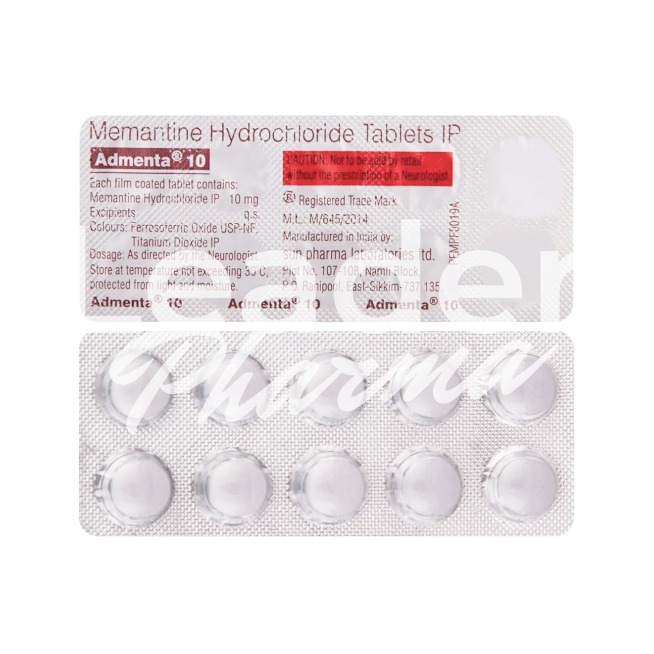
Just one strength is stocked, the 10 mg film-coated tablet, in boxes of 30, 60, 90, 120 or 180. The pack pictured is an imported generic rather than a UK-licensed pack. In the UK the medicine is prescription-only (POM). The originator brand here is Ebixa from Lundbeck; licensed generic versions come as 10 mg and 20 mg tablets, and there are also an oral solution and orodispersible tablets such as Valios and Mentino for those who find swallowing difficult.
Starting dose and the weekly build-up
The SmPC sets out a three-week climb in 5 mg steps so the body can adjust. During days 1 to 7 the daily amount is half a tablet; for days 8 to 14 it is one whole tablet; for days 15 to 21 it is one and a half. From the fourth week onwards the usual dose is 20 mg taken once a day, and that figure is also the stated maximum, so the larger packs simply provide a longer supply rather than a higher dose. The tablets go down with a drink of water at roughly the same time every day, either with a meal or on an empty stomach. A course of memantine should only begin when a carer is on hand to check that each dose is actually taken, and the benefit is normally reviewed within about three months of starting.
Kidney function, liver function and age
Mildly reduced kidney function (creatinine clearance 50 to 80 ml/min) needs no change. With moderate impairment (30 to 49 ml/min) the daily dose is 10 mg; if that is well tolerated for at least a week it may be taken up to 20 mg using the normal steps. Severe impairment (5 to 29 ml/min) means staying at 10 mg a day. Mild or moderate liver problems do not call for an adjustment, whereas use in severe liver impairment is not advised because there are no data. Older patients follow the standard adult scheme. There is no information on use in children.
Cautions and medicines that do not mix well
Allergy to the active ingredient or any excipient is the one contraindication. Extra care is wise for anyone with epilepsy or past seizures, and for people who have recently had a heart attack, have heart failure that is not compensated or have poorly controlled blood pressure. Anything that pushes urine pH upwards, including a sharp change to a vegetarian diet, regular use of alkalising indigestion remedies, renal tubular acidosis or a serious urinary infection with Proteus, can raise blood levels. Amantadine, ketamine and dextromethorphan work on the same receptor and the combination is best avoided. Levodopa, dopamine agonists and anticholinergics may have a stronger effect, while barbiturates and antipsychotics may be weakened; baclofen and dantrolene doses might need changing. Cimetidine, ranitidine, procainamide, quinidine, quinine and nicotine may compete for the same route of excretion through the kidneys, and anyone on warfarin should have their INR checked more closely. Use in pregnancy is reserved for clear need, and breastfeeding is not recommended.
Side effects reported with treatment
Unwanted effects of memantine are usually mild or moderate. Among the common ones are headache, drowsiness, dizziness, unsteadiness, constipation, breathlessness, higher blood pressure, changes in liver blood tests and allergic reactions. Less often people notice confusion, hallucinations, tiredness, vomiting, fungal infections, an altered walking pattern, venous blood clots or heart failure, and fits are rare. Dizziness and sleepiness can affect driving or working with machinery. Report anything new or worrying to the GP; for a severe reaction, call 999 or go to A&E.
Prescriber's role
Whether memantine is right, and whether it continues, is decided by the specialist or GP who reviews the patient's progress.